RNA Journal Club 11/5/09
Distinct Argonaute-Mediated 22G-RNA Pathways Direct Genome Surveillance in the C. elegans Germline
Weifeng Gu, Masaki Shirayama, Darryl Conte, Jessica Vasale, Pedro J. Batista, Julie M. Claycomb, James J. Moresco, Elaine M. Youngman, Jennifer Keys, Matthew J. Stoltz, Chun-Chieh G. Chen, Daniel A. Chaves, Shenghua Duan, Kristin D. Kasschau, Noah Fahlgren, John R. Yates, Shohei Mitani, James C. Carrington and Craig C. Mello
Molecular Cell 36: 231-244, 1 October 2009.
doi:10.1016/j.molcel.2009.09.020
This week’s comprehensive summary/analysis by Michael Nodine:
Upon screening for mutants defective in RNAi, Craig Mello’s group found that the DICER-RELATED HELICASE-3 (DRH-3) gene was required for germline and soma RNAi. Gu et al. also found that DRH-3 was required for endogenous siRNA (esiRNA) production and/or stability. When examining the requirement of DRH-3 for esiRNA production more closely, they found that DRH-3 was involved in the production of a specific class of esiRNAs, which they termed the 22G-RNAs due to their length and preference for a 5’ guanosine. 22G-RNAs were found to not have 5’-monophosphates, which are typically found in DICER products, and this observation led the authors to hypothesize that 22G-RNAs are RNA-dependent RNA polymerase (RdRP) products rather than DICER products. They then cloned small RNAs from wild-type and drh-3 samples using a 5’-independent ligation method, and found that 22G-RNAs mapped to ~50% of the protein coding genes annotated in the C. elegans genome.
Interestingly, 22G-RNAs tended to map to the 3’-ends of genes and there was less of a requirement for DRH-3 for 22G-RNAs derived from gene 3’-ends. Since the drh-3 mutants contained point mutations in the conserved helicase domain, this hinted at the possibility that DRH-3 may be part of an RdRP complex and may facilitate its movement along the RNA template by removing inhibitory secondary structures. Consistent with this idea, they found that two RdRPs were redundantly required for 22G-RNA production, and that these two RdRPs along with the tudor domain-containing protein EKL-1 interacted with DRH-3.
They then went on to find that worm-specific Argonautes (WAGOs) were redundantly required for 22G-RNA production. Genes, transposons, pseudogenes and cryptic loci were all found to be targets of 22G-RNAs, and components of the non-mediated decay (NMD) pathway were demonstrated to play a role in the biogenesis of at least a subset of 22G-RNAs. Gu et al. also demonstrated when and where 22G-RNAs function during worm development. WAGO-1 was localized to P-granules, which are localized just outside nuclear pores in the female germline and are thought to play a role in maternal RNA repression and storage. In addition, high-throughput sequencing and developmental northerns suggested that 22G-RNAs are enriched in the female germline and maternally inherited.
Thus, 22G-RNAs are key components of a surveillance pathway, which operates in the female germline and represses protein coding genes, pseudogenes and transposons. Presumably, incorrectly processed protein coding transcripts are targets for 22G-RNA biogenesis/action. However, it remains unknown how aberrant transcripts are recognized. Transcripts lacking poly(A) tails were previously demonstrated to be better substrates for C. elegans RdRPs in vitro, and incorrectly processed transcripts are better substrates for RdRP-dependent RNAi in plants. Fission yeast nucleotidyl transferases have been implicated in the recognition of aberrant transcripts by RdRPs and exosomes, and a homologous nucleotidly transferase, as well as a 3’-5’ exonuclease were found to be required for 22G-RNA production. Based on these observations, the authors suggest that a nucleotidyl transferase and a 3’-5’ exonuclease, both of which were shown to be required for 22G-RNA production, may function in an exosome-like complex to recognize aberrant transcripts and/or recruit the 22G-RNA RdRP complex. Finally, 22G-RNA pathway components are subcellularly positioned just outside female germline nuclei. Based on their observations, the authors hypothesize that 22G-RNA components may ‘monitor’ the female germline transcriptome and thus function in the surveillance of maternally-inherited RNAs.
Five thousand views? HECK YES.
I know there are some blogs that get ~5,000 views per hour, while it took 7.5 months for You’d Prefer An Argonaute (YPAA), but hot damn, I don’t care. The mild success of YPAA proves RNA science is quite worthy of the blogosphere, worthy of interest and debate among scientists online, just as I originally intended.

Figure 1. Views per month since March 2009, when YPAA was born.
Most of the credit should go to my fabulous contributers for the RNA Journal Club posts: (in order of contribution) Anna, Joel, David W., Anonymous 1, Michael, Robin, Noah, Graeme, Anonymous 2, Anonymous 3, Vikram, David W. (2nd time), Jenny, and Anna (2nd time). These folks rock, they make YPAA what it is.
As the foundation for starting YPAA, the MIT RNA Journal Club–its organizer Margaret, and its many attendees–should also be acknowledged. (And the sponsors keep us coming by paying for lunch!)
Thanks also to my mom for hitting refresh 4,900 times. And of course YOU.
Thanks for visiting, please come again.
RNA Journal Club 10/29/09
qiRNA is a new type of small interfering RNA induced by DNA damage
Heng-Chi Lee, Shwu-Shin Chang, Swati Choudhary, Antti P. Aalto, Mekhala Maiti, Dennis H. Bamford & Yi Liu
Nature 459: 274-277, 14 May 2009.
doi:10.1038/nature08041
This week’s aufschlussreiche summary and analysis by Anna Drinnenberg:
The term “quelling” refers to a posttranscriptional gene silencing phenomenon observed in Neurospora crassa, and was one of the first RNAi pathways to be described (Romano and Macino, 1992). Quelling is triggered by the expression of transgenes, also called “aberrant RNAs,” and results in silencing of both transgenes and cognate endogenous transcripts. It involves the production of double-stranded RNA (dsRNA) by an RNA-dependent RNA polymerase (QDE-1) using the transgenic mRNA as a template. Subsequently, one of two Dicer proteins (DCL-1 and DCL-2) cleaves the dsRNA substrate into small RNA duplexes that get loaded into an Argonaute effector complex containing QDE-2. After cleavage and exonucleolytic digestion of the passenger strand, the other siRNA strand functions as a guide strand in QDE-2 to degrade homologous endogenous transcripts. The physiological role of quelling is thought to be control of transposon expansion in order to preserve genomic integrity.
The authors of this study suggest a new physiological role for components of the quelling pathway in the response to DNA damage. During the process of studying the regulation of QDE-2 they noticed that the expression of QDE-2, at both the mRNA and protein level, is upregulated upon DNA damage caused by adding Histidine, EMS, or Hydroxyurea to the media. Immunoprecipitating QDE-2, they identified a new class of small RNAs ~21nt in length whose abundance is increased in the IP following DNA damage. Interestingly, these small RNAs appear to be shorter than the previously identified siRNAs (~25nt) of the quelling pathway that are produced by the same Dicer proteins (Catalanotto et al., 2004). It will be interesting to determine if the Dicer proteins, that are thought to act redundantly (Catalanotto et al., 2004), can produce small RNAs of different lengths or if the interaction with a cofactor could determine the cleavage interval on the dsRNA substrate.
Most of the small RNAs, which they referred to as “qiRNAs,” are derived from the sense and antisense strands of an rDNA array exceeding the regions that are transcribed into rRNA by Pol1, suggesting that a distinct transcript gives rise to the precursor (aberrant RNA) for the qiRNAs. They noticed that the production of aberrant RNA was not inhibited by thioelutin, a known inhibitor of RNA polymerases. In an attempt to identify the protein that produces the initial qiRNA precursor transcript from the rDNA array, they observed that QDE-1, already known to have RdRP catalytic activity, can also synthesize RNA transcripts using a DNA template. This is a very interesting observation and raises the question if RdRPs in other organisms also have DNA-dependent RNA polymerase activity. Such an activity would make the production of precursor RNAs for small RNAs independent from the canonical transcription pathway for the majority of other cellular RNAs.
In trying to assign a role to the qiRNAs, the authors noticed that the decrease in protein production upon DNA damage is partially blocked in QDE-1 and QDE-3 mutant strains. Moreover, QDE-1 and DCL-1/DCL-2 mutants show increased sensitivity to DNA damage reagents. These observations certainly provide a first hint of function of this pathway. A more detailed follow-up experiment could be a more precise demonstration that the qiRNAs in complex with QDE-2 directly downregulate rRNA transcripts (but this experiment was beyond the scope of this study).
Another recent publication from Cerere and Cogoni (Cecere and Cogoni, 2009) suggests that the small RNAs are involved in copy number control of the rDNA locus, possibly preventing recombination within the array. Changes in the heterochromatic state of the rDNA array could unify both observations: the block in downregulation of the transcripts and the increased recombination rate. Moreover, high-throughput sequencing of the small RNAs as well as RNAseq analysis in Neurospora crassa upon DNA damage might also identify other qiRNA sources and their potential targets.
References:
Catalanotto, C. et al. (2004). Redundancy of the two dicer genes in transgene-induced posttranscriptional gene silencing in Neurospora crassa. Mol Cell Biol 24, 2536-2545.
Cecere, G., and Cogoni, C. (2009). Quelling targets the rDNA locus and functions in rDNA copy number control. BMC Microbiol 9, 44.
Romano, N., and Macino, G. (1992). Quelling: transient inactivation of gene expression in Neurospora crassa by transformation with homologous sequences. Mol Microbiol 6, 3343-3353.
Venki Ramakrishnan: the Cadillac of ribosome structure investigators


Give this man a Nobel Prize. Give it to him.
I know before I’ve made clear my affection for Harry Noller, and that affection still remains strong like a peptide bond, but lately I’m head over heels (head over sneakers) for Venki Ramakrishnan. Last week in his lecture for the MIT Biology Colloquium, Venki Ramakrishnan charmed me and several hundred other people with his humor, smarts, and beautiful structural work.
The scene of Venki’s lecture, titled “How the ribosome facilitates selection of the right tRNA during decoding of the message,” was quite a spectacle. There was an electricity in the air. Never had I seen room 32-123 so packed. Every seat was taken, of course, and there were at least one-hundred other people huddled in the back of the lecture hall, down the stair aisles, in front, everywhere. Some professors were seated on the concrete floor.
Venki’s faculty host had warned the audience before the lecture began that the aisles had to be clear (for fire safety reasons), and so they were cleared. But sure enough, ~10 minutes into Venki’s lecture, the honorable MIT campus police unkindly entered the room and, temporarily, ruined some beautiful science.
It was quite funny: Venki was captivating us from the lectern, as he faced a projection screen to his left. To his right, a plump MIT police officer sauntered in, unbeknownest to Venki, but knownest to everyone else in the room. The copper reached his arm out to the lectern to capture Venki’s attention, Venki stopped talking, and the officer motioned to follow him outside the lecture hall. Totally perplexed, Venki obliged and left the room, to a chorus of boo’s directed at the police. Moments later, Venki emerged calm as a clam, and succinctly directed movement of his audience into a fire-escape safe arrangement so that his lecture could continue.
Imagine what Venki’s story could sound like: “I won the Nobel Prize, went to MIT, and was accosted by the campus police at my own lecture!”
Venki gave a beautiful introduction, even making a jab at Jim Watson (Watson the man, not Watson the scientist). (He also later hilariously and appropriately mocked Tom Steitz.) He then proceeded to give the best structural biology talk I have ever seen.
He described how proper base pairing between the tRNA anticodon to the mRNA codon induces subtle structural movements between that end of the tRNA and small subunit RNA that are transmitted up through the tRNA toward its aminoacyl end, inducing residue movement in EF-Tu leading to GTP hydrolysis–a cascade of events leading to EF-Tu release and aa-tRNA incorporation. (For more, see Venki’s recent review.)
He ended by narrating an incredibly cool animated movie of all the ribosome structural movements he had just described in detail, and then reprised the movie with a version set to a soundtrack of snippets of classic pop tunes (e.g. by The Clash, David Bowie, etc.), arranged by his lab. The lyrics spoke to the molecular movements spotlighted in the movie. It was very entertaining.
I realize I could have proclaimed Venki the “Rolls-Royce” of ribosome investigators, since he’s at the MRC. But no. He’s American; he’s a Caddy.
Strange Cambridge Fauna
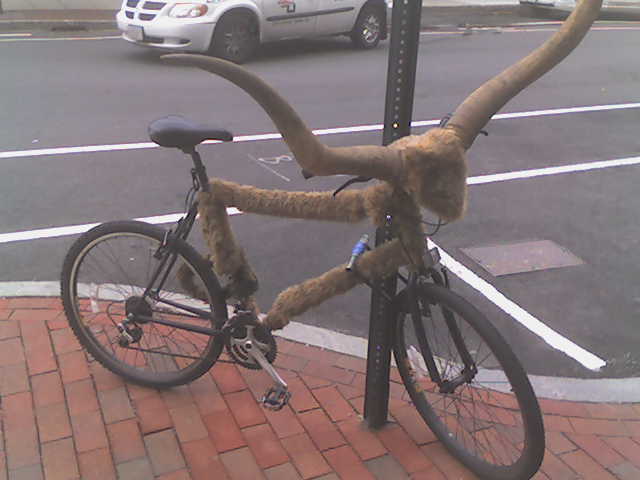
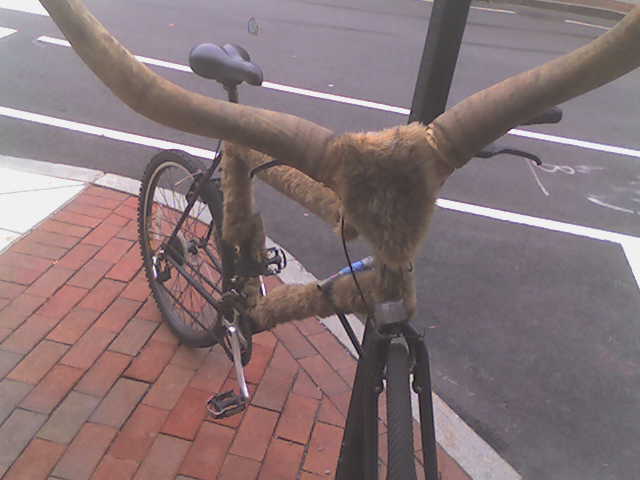
From my archives–spotted near Central Square in autumn. Untill this, neither in the wild nor in the laboratory was I aware of success in mating a large, furry, horned animal to a mountain bicycle. U-locked to a signpost, I was unable to mount and ride the forsaken beast. No sightings since.
RNA Journal Club 10/22/09
Aster H. Juan, Roshan M. Kumar, Joseph G. Marx, Richard A. Young and Vittorio Sartorelli
Molecular Cell 36 (1): 61-74, 9 October 2009.
doi:10.1016/j.molcel.2009.08.008
CNN=science journalism pretty not good
In my daily (hourly), incredibly narcissistic practice of reading my own blog (the one you’re reading right now), I traveled back to my October 7th post about how Harry Noller got screwed by being overlooked for the Nobel Prize for work on the ribosome. Below the post, under WordPress’s automatically generated “possibly related posts,” was a link to a CNN article with an amusing, although I suppose technically accurate title:
“Chemistry Nobel honors research on life-giving ribosome”
“Life-giving” ribosome? Ha. Yes. I remember that’s exactly how Harry Noller introduced it to us in Biochem 100A back in college. So next time you say grace/thanks, thank the ribosome for giving you life. Ok?
Following the title is an underwhelming article. At least there’s a nice picture of Tom Steitz sportin’ his trademark frosty chinstrap beard. I’m not making fun–if I could pull that off, I would try. And now with a Nobel in his pocket (around his neck perhaps), that look is certified OG.
RNA Journal Club 10/15/09
Robust discrimination between self and non-self neurites requires thousands of Dscam1 isoforms
Daisuke Hattori, Yi Chen, Benjamin J. Matthews, Lukasz Salwinski, Chiara Sabatti, Wesley B. Grueber & S. Lawrence Zipursky
Nature 461 (7264): 644-648, 1 October 2009.
doi:10.1038/nature08431
Evolution in a Test Tube
David Bartel’s career as a biochemist began marked by tension between his exceedingly meticulous method and the most careless of biological processes. Evolution, the process in which living things change and diversify from their predecessors, is random, at moments appears illogical, and leads to many dead ends. But in a seminal paper published in 1993, with clear thought and clever technique Bartel, along with thesis advisor Jack Szostak, brilliantly distilled the highly complex nature of evolution literally into a test tube.
Bartel focused on “ribozymes,” a class of molecules composed entirely of ribonucleic acid (RNA) that catalyze chemical reactions. Starting from a synthetic large pool of different RNA molecules of random sequence, he used a technique called in vitro selection to isolate a new type of ribozyme that performed a specific chemical reaction, known as an RNA ligation, otherwise only attributed to natural protein based enzymes. He then evolved these ribozymes by introducing random mutations into their sequence and re-isolating more active versions that outcompeted earlier variants—in effect modeling evolution in a test tube.
Naturally occurring ribozymes are rare—a host of enzymatic activities they may have once possessed have been appropriated to faster and more accurate proteins during evolution—but owing to their structural similarity to DNA, and catalytic potential, they are attractive candidates for the original self-replicating macromolecules, predating more complex life forms.
While generation of a self-replicating ribozyme remains elusive, and would not prove that catalytic RNAs directly preceded life, Bartel’s study was paramount in demonstrating the ability to isolate ribozymes with new activities. He notes, “We’re left with lots of gaps in knowing how RNA based life forms might have emerged, but it is still useful to know what RNA can do.”
Appreciating the highly mutable nature of evolution, Bartel also recognizes that the particular ribozyme he isolated was only one possible outcome of the experiment. “Evolution is the sum of a huge number of chance events, and the biological world is the culmination of all these chance happenings,” says Bartel. “If you replayed a tape of biological evolution, we would all look different.”
Reference: Bartel and Szostak, Science 261, 1993.
I wrote the piece above for another assignment for my science journalism class. The assignment was a “front of the book” magazine piece, written for an audience interested in science, but probably not very knowledgeable about RNA or ribozymes.
We were instructed to pick a paper we are (were, have been, etc.) excited about, and interview one of the authors or an expert in the field. Ribozymes are what first sparked my interest in RNA back in college, so I picked my favorite ribozyme paper. And conveniently, being at MIT, I had the opportunity to interview Professor David Bartel, the first author of the paper.
RNA Journal Club 10/8/09
Helena Persson, Anders Kvist, Johan Vallon-Christersson, Patrik Medstrand, Åke Borg and Carlos Rovira
Nature Cell Biology AOP, 13 September 2009.
doi: 10.1038/ncb1972
Harry Noller got shafted by the 2009 Nobel Prize in Chemistry
“For studies of the structure and function of the ribosome,” the prize was awarded. Why not Harry Noller then, whose entire illustrious career has focused on the structure and function of the ribosome? That’s bullshit.
Unfortunately this egregious omission by the Nobel Assembly pollutes recognition of momentous work that has taught us so much about what RNA can do.
(Santa Cruz Sentinel article with Harry’s reaction here.)
Da Prize
You’ve probably heard the news by now: the 2009 Nobel Prize in Physiology or Medicine was awarded to Elizabeth Blackburn, Carol Greider and Jack Szostak for the discovery of “how chromosomes are protected by telomeres and the enzyme telomerase,” in the words of the Nobel Assembly. Awesome. Congrats to these superb researchers for their smashing work.
An “unsentimental education”
I’ve been thinking about graduate school and mental health recently. Depending on circumstances, working toward a Ph.D. can bring about pressures on the mind strong enough to disturb it. Situations that end in the most extreme outcomes, like suicide, of course can probably never be fully attributed to an experiment gone wrong, an adviser gone wrong, an institution, or impending dismal career prospects. These cases are highly personal; many other people in otherwise identical circumstances would not react the same way. So look out for your chums, and your non-chums/co-workers too.
I was considering writing a piece about mental health among grad students at MIT, although I have now dropped the idea–too close to home I think. But while I was still investing interest in this story, a teacher refered me to an article, by Stephan S. Hall, that appeared in The New York Times Magazine in November, 1998, titled “Lethal Chemistry at Harvard”. It is an excellently written, but nonetheless very sad story about a graduate student in the chemistry department at Harvard who took his life in 1998. In the story, Hall wrote a paragraph describing the archetypal journey of a graduate student in the sciences. I found it so realistic that I think it’s worth reprinting:
Graduate study in the sciences, however, is a very unsentimental education. It requires the intellectual evolution from undergrad who can ace tests of textbook knowledge to original thinker who can initiate and execute research about which the textbooks have yet to be written. What is less often acknowledged is that this intense education involves an equally arduous psychological transition, almost a second rebellious adolescence. The passage from callow, eager-to-please first-year student in awe of an often-famous faculty adviser to confident, independent-minded researcher willing to challenge, and sometimes defy, a mentor is a requisite part of the journey.
I haven’t gotten to the defy your mentor stage yet, but boy I can’t wait. I’ve seen others do it and it looks pretty cool.

 You'd Prefer An Argonaute
leave a comment