RNA Journal Club 5/26/11
Structure of C3PO and mechanism of human RISC activation
Xuecheng Ye, Nian Huang, Ying Liu, Zain Paroo, Carlos Huerta, Peng Li, She Chen, Qinghua Liu & Hong Zhang
Nature Structural & Molecular Biology AOP, 8 May 2011.
doi:10.1038/nsmb.2032
This week’s terrific summary and analysis by Alex Subtelny:
An important and lingering question in the biochemistry of mammalian RNAi is how a small RNA duplex is loaded into Argonaute (Ago), the core component of the RNA-induced silencing complex (RISC). Previously, several groups reported that this process is mediated by Dicer and TRBP, including one which showed that RISC loading and activation could be reconstituted in vitro with purified human Ago2, Dicer, TRBP and a pre-miRNA hairpin (MacRae et al., 2008). However, this model is challenged by the findings that (1) miRNAs injected into zebrafish embryos lacking both maternal and zygotic Dicer are capable of repressing target mRNAs (Giraldez et al., 2005; admittedly, this finding is from a non-mammalian system, although one that could be relatively similar to mammals in terms of RISC loading), and (2) ATP greatly enhances loading of human RISC (Yoda et al., 2010), consistent with the involvement of Hsc70/Hsp90, which was later shown to promote RISC loading in Drosophila and human (Iwasaki et al., 2010). Two years ago, Qinghua Liu and colleagues reported the discovery in Drosophila of C3PO, a complex of Trax and translin proteins that possesses endoribonuclease activity and promotes RISC activation, apparently by removing the cleaved passenger strand of a loaded siRNA duplex. Trax and translin are conserved to humans, raising the question of whether C3PO functions analogously in mammals. Moreover, since the authors of the present study failed to reconstitute RISC activity in vitro with purified human Ago2, Dicer, TRBP and double-stranded siRNA duplex (ds-siRNA), another question is which other factors are required for mammalian RISC loading and activation (and whether C3PO is one of these).
In this paper, Ye et al. reconstitute RISC activity with human Ago2, ds-siRNA and C3PO, and show that the latter is required for the efficient removal of the Ago2-cleaved passenger strand. Moreover, they report the crystal structure of human C3PO, which resembles a partial structure of the Drosophila C3PO complex reported in a simultaneous advance online publication in NSMB (Tian et al., 2011). To identify the factors that activate human RISC, the authors supplied purified hAgo2 with ds-siRNA and chromatographic fractions of HeLa extract, and measured cleavage of a target mRNA with a fully complementary sequence to the siRNA guide strand. The fractions containing TRAX and translin reconstituted ds-siRNA programmed RISC activity when combined with hAgo2, as did purified recombinant C3PO. How, then, to reconcile these results with previous reports of Ago2, Dicer and TRBP being necessary and sufficient for RISC activation? Ye et al. found that Dicer and TRBP did not enhance ds-siRNA programmed RISC activity in the presence of C3PO or that these two factors were even necessary for ds-siRNA binding by hAgo2, but that they were required together with C3PO for shRNA-triggered target cleavage. Thus, Dicer and TRBP appear to function exclusively in converting a precursor hairpin into a mature siRNA duplex. The ability of MacRae et al. to reconstitute RISC activity with Dicer and TRBP can be explained if the pre-miRNA they used somehow acted as an ss-siRNA, which for mammalian Agos can initiate RISC activity as such in the absence of C3PO. In support of this explanation, Yoda et al. found that cleavage of a target RNA could be achieved with only purified recombinant hAgo2 programmed with a pre-miRNA whose 5’ arm was complementary to the target. After demonstrating that C3PO is required for RISC activation in vitro, Ye et al. showed that this result is relevant in vivo by rescuing ds-siRNA programmed target cleavage in translin-null MEF cell lysates and cells with purified C3PO and a translin transgene, respectively.
The authors then performed what was almost certainly the non-trivial task of obtaining a crystal structure of the human C3PO complex, using full length Trax and translin. The complex is a barrel-shaped hetero-octamer containing six translin and two TRAX subunits that enclose a central cavity. The top and bottom “halves” of the barrel, each of which consists of one TRAX and three translin molecules, possess a right-handed superhelical shift that is formed by interactions between TRAX and translin #1 and between adjacent translins and abolished at the interface between translin #3 and TRAX. The authors believe that this shift accounts for why C3PO exhibits only a single stoichiometry and arrangement of subunits. Indeed, ablating two salt-bridge interactions at the translin #3-TRAX interface yielded complexes of abnormal stoichiometry and greatly reduced C3PO ssRNA binding and cleavage activity. Intriguingly, the four putative catalytic Glu and Asp residues of C3PO (identified by conservation and by their proximity to the sole Mn2+ ion in a second, co-crystal structure of C3PO and Mn2+) are located inside the barrel. Mutating these amino acids abolished ssRNA cleavage, but not binding (whereas mutating several nearby basic residues thought to interact with the ssRNA backbone resulted in a loss of both activities. These mutations did not perturb the structure of the complex, based on size-exclusion chromatography analysis). To support their hypothesis that ssRNA cleavage occurs in the interior of the complex, Ye et al. showed that incubating C3PO with an ssRNA shifted its gel filtration profile by the molecular weight of the RNA. Moreover, the catalytic (and RNA-binding) mutants of C3PO were incapable of activating ds-siRNA programmed RISC activity when combined with hAgo2. Finally, the authors showed that removal of the passenger strand fragments generated by Ago2 cleavage is not a passive process, but is promoted by the endonuclease activity of C3PO, as also appears to be the case for fly RISC. Importantly, C3PO prefers to act on a nicked duplex; little passenger strand degradation was seen when purified C3PO was incubated with intact siRNA duplex.
All in all, this paper is a very impressive combination of biochemistry and structural biology, providing insight into how C3PO activates RISC and how it works as a macromolecular machine. Nevertheless, one is left wondering how an ssRNA substrate can access the catalytic residues in the interior of the octamer. The authors posit several models for this, including one where the C3PO octamer transiently opens to let an ssRNA into the barrel and another where C3PO binds a substrate as a tetramer prior to formation of the full octamer (somewhat analogously to the bacterial GroES/GroEL chaperonin complex). A direct demonstration that an ssRNA substrate can enter the interior of the C3PO barrel might be a co-crystal structure of C3PO and cleavage-resistant ssRNA, though this approach is not without problems (including poor resolution for the electron density map of the ssRNA if the RNA is conformationally flexible inside the barrel, and potentially limited physiological relevance of the complex in the crystal). Another question is whether additional factors may work together with C3PO to promote passenger strand removal from an Ago-loaded small RNA duplex in mammals. Regardless of these unresolved questions, this paper represents an important piece of the puzzle of how an active RISC complex is formed, and is also an enjoyable read.
RNA Journal Club Classic
Cleaning out my drawer yesterday, I dug up the papers I presented in RNA Journal Club prior to the birth of YPAA. So for posterity’s sake:
Host Immune System Gene Targeting by a Viral miRNA
Noam Stern-Ginossar, Naama Elefant, Albert Zimmermann, Dana G. Wolf, Nivin Saleh, Moshe Biton, Elad Horwitz, Zafnat Prokocimer, Mark Prichard, Gabriele Hahn, Debra Goldman-Wohl, Caryn Greenfield, Simcha Yagel, Hartmut Hengel, Yael Altuvia, Hanah Margalit, Ofer Mandelboim
Science Vol. 317 no. 5836, pp. 376-381, 20 July 2007.
DOI: 10.1126/science.1140956
They named their algorithm “Reptar”, in obvious reference to the Rugrats character.

space
Transcription Factors Bind Thousands of Active and Inactive Regions in the Drosophila Blastoderm
Xiao-yong Li, Stewart MacArthur, Richard Bourgon, David Nix, Daniel A. Pollard, Venky N. Iyer, Aaron Hechmer, Lisa Simirenko, Mark Stapleton, Cris L. Luengo Hendriks, Hou Cheng Chu, Nobuo Ogawa, William Inwood, Victor Sementchenko, Amy Beaton, Richard Weiszmann, Susan E. Celniker, David W. Knowles, Tom Gingeras, Terence P. Speed, Michael B. Eisen, Mark D. Biggin
PLoS Biology | Volume 6 | Issue 2 | e27 | February 2008.
doi:10.1371/journal.pbio.0060027
Oh man, I don’t know what I was thinking in doing this paper. In trying to escape the endless Nature/Science/Cell journal club rut, I landed in this fine PLoS paper–this fine 24-page, 15 main-text figure (+12 Sup Fig), ~12,000-word PLoS paper.
space
A discontinuous hammerhead ribozyme embedded in a mammalian messenger RNA
Monika Martick, Lucas H. Horan, Harry F. Noller & William G. Scott
Nature 454, 899-902, 14 August 2008.
doi:10.1038/nature07117
Ribozymes will always be the coolest RNAs out there, ‘specially hammerheads up in ur 3’UTRses!!
RNA Journal Club 6/9/11
Global quantification of mammalian gene expression control
Björn Schwanhäusser, Dorothea Busse, Na Li, Gunnar Dittmar, Johannes Schuchhardt, Jana Wolf, Wei Chen & Matthias Selbach
Nature 473, 337—342, 19 May 2011.
doi:10.1038/nature10098
RNA Journal Club 6/2/11
Reprogramming transcription by distinct classes of enhancers functionally defined by eRNA
Dong Wang, Ivan Garcia-Bassets, Chris Benner, Wenbo Li, Xue Su, Yiming Zhou, Jinsong Qiu, Wen Liu, Minna U. Kaikkonen, Kenneth A. Ohgi, Christopher K. Glass, Michael G. Rosenfeld & Xiang-Dong Fu
Nature AOP, 15 May 2011.
doi:10.1038/nature10006
Naked DNA
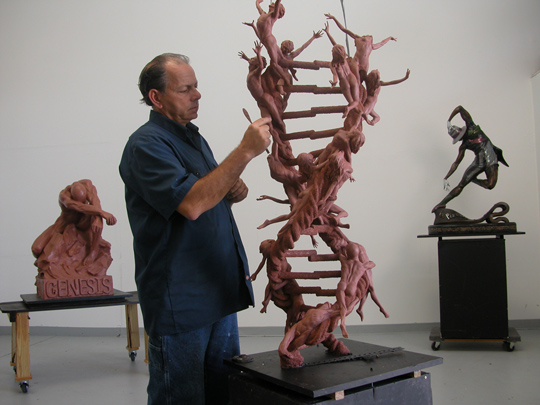

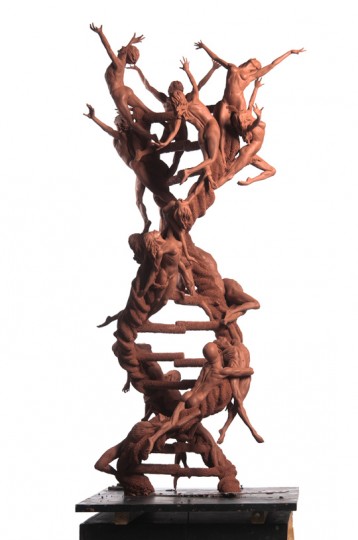
Sculptor Franco Castelluccio’s new work, “Double Helix XX-XY”, via Curated Magazine.
RNA Journal Club 5/19/11
Ribosome-Mediated Specificity in Hox mRNA Translation and Vertebrate Tissue Patterning
Nadya Kondrashov, Aya Pusic, Craig R. Stumpf, Kunihiko Shimizu, Andrew C. Hsieh, Shifeng Xue, Junko Ishijima, Toshihiko Shiroishi, and Maria Barna
Cell 145, 383–397, 29 April 2011.
DOI 10.1016/j.cell.2011.03.028
FalconCAST
More than a year ago a pair of Peregrine Falcons made their new home on the roof of our institute. They endeared us with their swooping through the air, their calling and playing, and their leaving various rodent body parts on outside windowsills. So cute!


This spring some furry chicks emerged, and now one can watch the whole family on a live webcam, FalconCAST. It’s a way to kill that time during your 4 degree spin. See the chicks roost, feed, and projectile poop.
Update 6/15/11
Man, they grew up fast. The following message was posted on our internal site this morning:
The falcons that hatched on Whitehead’s 7th floor have fledged and left their nest. Two of the falcons flew off earlier last week, and the last one departed on Saturday, June 11th. The parents will continue to feed the fledglings as the young learn the finer points of flying and mid-air hunting. Because the nest is no longer occupied, the FalconCast has been turned off.
Update 2012
The falcons and FalconCast are back online with hi-res camera.
A.G. 51-100

blank

blank
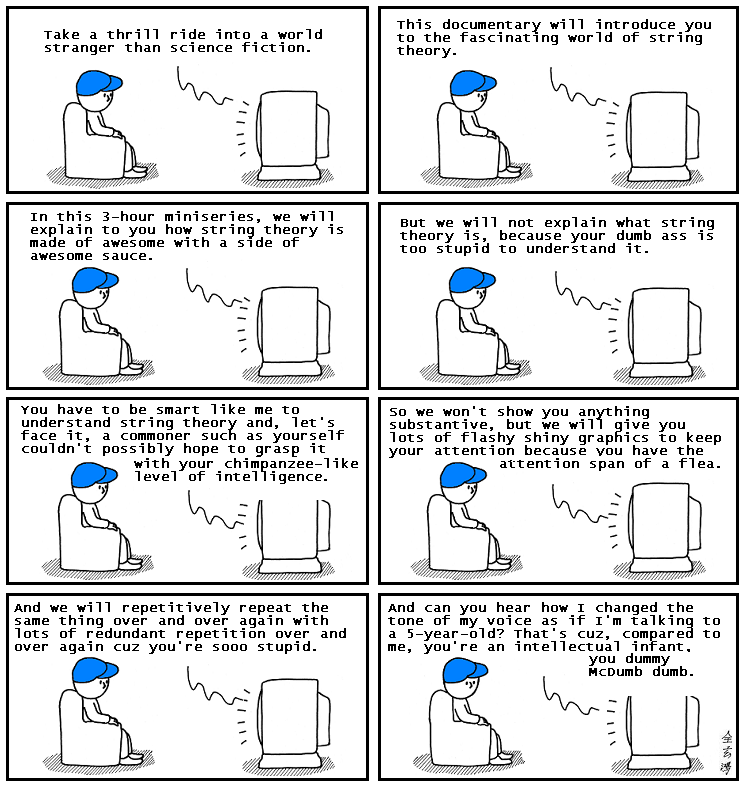
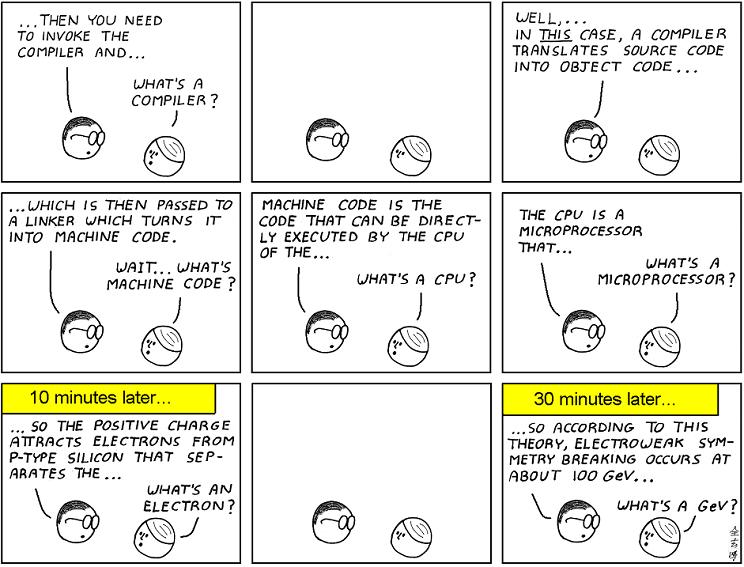
Fairly accurate reflection on what science on TV has come to these days. A couple of years ago I heard a talk by Paula Apsell, the senior executive producer of NOVA, in the MIT Physics Colloquium series, and she was basically pleading the case that dumbing down (she didn’t use this term) NOVA-type programming was necessary to reach as wide an audience as possible–because science is under attack from tens of millions of policy makers and idiots in America, so we must fight them with entertainment!
Really?? Would we do the same thing to children in our schools?
When I watched science programming on TV as a kid, shows like NOVA, I didn’t understand everything. That’s why I became a scientist.
blank


http://909sickle.com/s/fuck-heisenberg/
blank

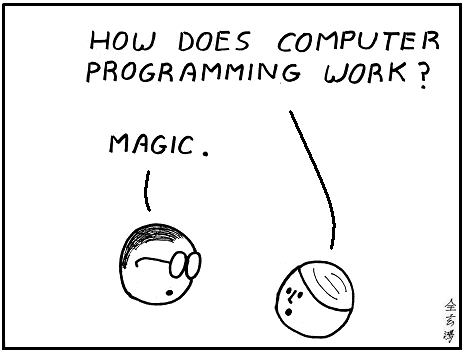
http://abstrusegoose.com/secret-archives/psa

blank
blank
RNA Journal Club 5/12/11
Can Cenik, Hon Nian Chua, Hui Zhang, Stefan P. Tarnawsky, Abdalla Akef, Adnan Derti, Murat Tasan, Melissa J. Moore, Alexander F. Palazzo, Frederick P. Roth
PLoS Genetics | Volume 7 | Issue 4 | e1001366 | April 2011.
doi: 10.1371/journal.pgen.1001366
RNA Journal Club 5/5/11
SON Controls Cell-Cycle Progression by Coordinated Regulation of RNA Splicing
Eun-Young Ahn, Russell C. DeKelver, Miao-Chia Lo, Tuyet Ann Nguyen, Shinobu Matsuura, Anita Boyapati, Shatakshi Pandit, Xiang-Dong Fu, and Dong-Er Zhang
Molecular Cell 42, 185–198, 22 April 2011.
DOI 10.1016/j.molcel.2011.03.014
RNA Journal Club 4/28/11
Mutations in the RNA Granule Component TDRD7 Cause Cataract and Glaucoma
Salil A. Lachke, Fowzan S. Alkuraya, Stephen C. Kneeland, Takbum Ohn, Anton Aboukhalil, Gareth R. Howell, Irfan Saadi, Resy Cavallesco, Yingzi Yue, Anne C-H. Tsai, K. Saidas Nair, Mihai I. Cosma, Richard S. Smith, Emily Hodges, Suad M. AlFadhli, Amal Al-Hajeri, Hanan E. Shamseldin, AbdulMutalib Behbehani, Gregory J. Hannon, Martha L. Bulyk, Arlene V. Drack, Paul J. Anderson, Simon W. M. John, Richard L. Maas
Science Vol. 331 no. 6024 pp. 1571-1576, 25 March 2011.
DOI: 10.1126/science.1195970
A.G. 101-150

space

space
space

RNA Journal Club 4/21/11
Sabine D. Jordan, Markus Krüger, Diana M. Willmes, Nora Redemann, F. Thomas Wunderlich, Hella S. Brönneke, Carsten Merkwirth, Hamid Kashkar, Vesa M. Olkkonen, Thomas Böttger, Thomas Braun, Jost Seibler and Jens C. Brüning
Nature Cell Biology 13 (4), April 2011.
DOI: 10.1038/ncb2211

 You'd Prefer An Argonaute
leave a comment